
“Super clone” is a term used in the replica-watch market to describe higher-grade counterfeits ones that attempt to match a luxury watch’s dimensions, weight, and movement more closely than a cheap knockoff. However, quality can differ considerably between models, manufacturing batches and individual watches. A replica watch may have an accurate-looking dial but an incorrect case thickness. Another may use a decorated movement that resembles the reference calibre while operating differently internally. The important question is therefore not whether every super clone watch is good. It is which aspects of a particular watch have been reproduced accurately and whether its advertised specifications can be verified. In this article, “super clone” refers to the term commonly applied to highest quality replica watches at superclonewatches.is (SCW). It is not an independently certified quality classification. For a complete explanation, read What Are Super Clone Watches? and AAA Replica vs Super Clone Watches.
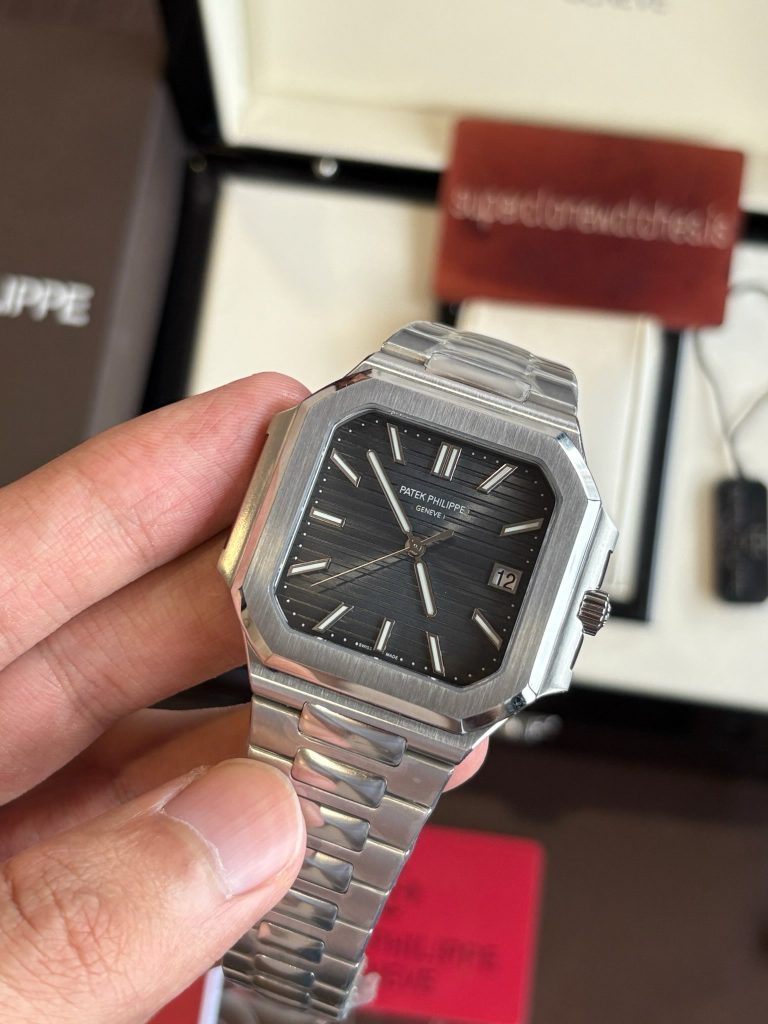
A Super Clone may reproduce the appearance of a reference watch closely, particularly when viewed in photographs or from an ordinary distance. Accuracy, however, involves more than appearance. The case, movement, bracelet, dial, finishing and operation must be considered separately. A visually convincing dial does not prove that the movement or materials are equally accurate.
The visual accuracy of a watch depends on details such as:
Lighting and image processing can change the appearance of colours and finishing. Current photographs taken from several angles are more useful than one heavily edited promotional image.
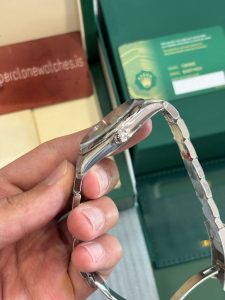
Case diameter, thickness and weight significantly affect how a watch looks and feels.
Some replica cases are thicker because the installed movement requires additional space. Others may reproduce the diameter correctly while using an inaccurate bezel, crown, mid-case or caseback profile.
Weight is not proof of quality. A heavier watch is not necessarily more accurate, particularly when the original model uses titanium, ceramic or another lightweight material.
Useful measurements include:
These details should be compared with the exact reference rather than another watch from the same collection.
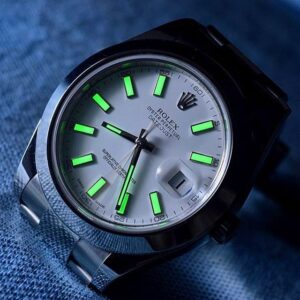
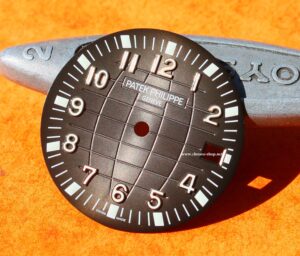
The dial is one of the most noticeable parts of a watch. Higher-grade versions may use more carefully applied markers, improved printing and textures designed to resemble the reference.
Differences can appear in:
Claims such as “perfect dial colour” should be treated cautiously. The same dial can appear different under natural light, artificial light and edited photography.
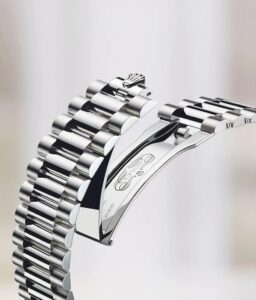
The bracelet plays a major role in both how the watch looks and how it feels on the wrist. The links should articulate naturally — not overly loose, stiff, or sharp-edged.
Key points to examine include:
A smoothly operating clasp or crown often points to better overall finishing, but this alone doesn’t confirm the accuracy of the watch as a whole.
Movement and Functional Accuracy
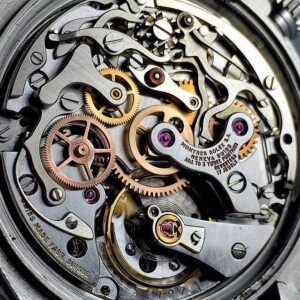
Super clone watches typically use movements built or decorated specifically to mimic the calibre found in the genuine reference piece. Other replicas rely on generic movements dressed up with decorative plates, bridges, or rotors to create a similar look.
Assessing a movement really comes down to two questions:
It’s worth noting that a movement can appear highly convincing through a display caseback while still differing internally — in construction, power reserve, or how it’s adjusted.
In 2026, at SCW(superclonewatches.is) a new wave of 1:1 replica watches emerged featuring movements built around a free-sprung balance.
For more in-depth coverage, see the Complete Clone Watch Movement Guide.
What Determines Their Quality?
The overall quality of any given watch depends on several interrelated factors.
Manufacturing Batch
Superclone models are often revised across different production runs. A newer batch might bring improvements to the dial, bracelet, or movement — but may also introduce new inconsistencies elsewhere.
The movement affects:
Descriptions such as “Swiss movement” or “exact clone calibre” should be supported with specific information. Movement decoration alone does not prove Swiss origin or identical internal construction.
High end clones are often marketed as using materials such as stainless steel, titanium, ceramic, carbon style composites, or precious-metal finishes.
When it comes to material descriptions, it’s important to distinguish between:
A case with a gold-like appearance shouldn’t be assumed to be solid gold simply based on colour. Likewise, the precise composition of a stainless-steel alloy can’t be reliably determined just by looking at it or judging its weight.
Finishing encompasses dial printing, brushing, polishing, engraving, and bracelet construction.
Quality-control inspections may cover:
Even within a well-produced batch, an individual unit can still turn out defective. Examining the actual watch in hand remains essential.
Even a visually convincing super clone can harbor identifiable differences from the authentic piece.
A substitute movement may need extra room, resulting in a thicker mid-case or caseback. This is often more noticeable from a side profile than in a front-on photo.
Sunburst, tapisserie, and horizontally textured dials are notoriously hard to replicate consistently. Colour, depth, and pattern spacing can shift depending on lighting conditions.
Discrepancies can show up in:
A perfectly centred date in one photo doesn’t guarantee every numeral will line up correctly.
Decorative plating can make a movement look like the reference calibre without actually matching its internal engineering.
Differences may show up in the balance’s positioning, the bridge layout, jewel placement, rotor motion, and the adjustment mechanism.
Lume can vary in colour, initial brightness, how it’s applied, and how long it lasts.
A photo taken right after exposure to bright light only demonstrates initial brightness — not how long the glow actually persists.
Trademarked names like “Chromalight” shouldn’t be applied to an unauthorized product just because the lume happens to share a similar colour.
Close inspection may reveal differences in engraving depth, typography, spacing, and alignment.
Serial numbers, reference numbers, clasp markings, and movement engravings shouldn’t be taken as proof of authenticity, since these details can be replicated.
A plated or coated case is not the same as solid gold or platinum. Product descriptions should clarify exactly which parts contain the stated material and how they were made.
There’s no one-size-fits-all lifespan.
Durability hinges on:
One watch might run smoothly for years, while another develops issues much sooner. A higher price tag or quality label is no guarantee of long-term reliability.
Servicing can also become tricky if the movement uses uncommon parts. Before counting on long-term durability, it’s worth considering the availability of replacement parts and qualified repair services.
Water resistance should never be taken for granted.
A model might carry an advertised depth rating even though the specific unit was never pressure tested. Gaskets, crown construction, crystal fit, and caseback sealing all play a role in how well it resists water.
A proper pressure test only tells you about that particular watch’s condition at the time it was tested — it’s not a lasting guarantee, especially once the case has been opened or the watch has taken an impact.
Unless a specific watch has been tested, it’s best to keep it away from swimming, showering, and extended water exposure.
Are Super Clone Watches Worth It?
Whether one seems worth it comes down to individual expectations and the specifications of that particular watch.
Anyone expecting it to fully match an authentic luxury watch is holding it to an unrealistic bar. Gaps may remain in:
The label “super clone” by itself says nothing about actual value. Current photos, measurable specs, functional testing, and clearly stated policies offer far more useful insight.
A factory name might hint at the claimed manufacturing source, but it can’t vouch for the condition or quality of any individual watch. For a full discussion of sellers and factories, read Buy the Seller, Not Only the Factory.
No. Some may reproduce visible details closely, but differences can remain in their movements, materials, dimensions, finishing, quality control and servicing.
Not necessarily. Some use Asian-manufactured movements, generic calibres or decorated movements. Claims of Swiss origin require specific supporting information.
Some are advertised as using 904L steel, while others use different alloys. Appearance and weight alone cannot reliably establish the exact steel composition.
Certain products may contain plated, wrapped or inserted gold components. A gold-coloured case should not be assumed to be solid gold without reliable information about its construction and composition.
Water resistance depends on the construction and condition of the individual watch. It should be checked using an appropriate pressure test.
There is no fixed lifespan. Longevity depends on the movement, assembly, maintenance, exposure to moisture and availability of compatible parts.
A knowledgeable examiner may identify differences through the movement, dimensions, materials, finishing or reference-specific details. No replica should be presumed impossible to identify.
Higher quality fake watches can reproduce certain visual and functional elements more closely than inexpensive imitations, but they should not be described as identical to genuine watches.
Measurable dimensions, movement information, current photographs and individual quality checks provide more useful evidence than absolute descriptions such as “perfect” or “exact.”